
“Yes, I have been vegan for over 10 years”, you tell your date across the table before you take another sip of coffee.
You are both sitting in a cozy coffee shop in the winter after having matched on a dating app.
“Oh wow,” she replies. “You know, I was actually vegan myself for two years. But honestly, it just got way too hard. I missed cheese too much, and it was so inconvenient when traveling.”
Her voice carries her words without a hint of shame. You immediately raise your eyebrow, and put your coffee mug down, feeling the weight of sudden disconnect.
“You used to be vegan?”, you reply hesitantly. “What’s the reason you stopped?”
“Oh, I still love animals!” she says, missing the point entirely as she turns to the barista to order a pastry packed with dairy. “I just realized I needed to listen to my body and do what works for me.”
“I’m not dating non-vegans again,” you mutter to yourself on the walk home.
Ex-vegans.
For anyone who has become vegan, this seems like a bewildering concept.
How could someone see what happened to innocent animals, decide to stop exploiting them, and then with eyes wide open choose to victimize them again after a few years?
She genuinely believed she used to be vegan because she felt a vague sense of compassion while avoiding animal products for a while. But compassion is a feeling; abolition is a principle. When an ethical stance rests on fleeting personal sentiment rather than an absolute boundary against treating sentient beings as property, it crumbles the moment life gets inconvenient.
Becoming ex-vegan has become a trend in and of itself in recent years. People proudly posting photos of animal flesh on their Instagram stories proclaiming: “I am no longer vegan!”.
In fact, there is this widespread notion that most people that went vegan end becoming ex-vegan.
These performative social media declarations feed into a convenient public narrative – the idea that veganism is just a phase that almost everyone eventually outgrows.
Non-vegans adore this narrative because it offers instant cognitive relief. If “everyone quits”, then continuing to exploit animals isn’t a moral failure – it’s just an inevitable reality.
But this idea is heavily anchored not just by people trying to get likes on social media. It is anchored by a single statistic: the headline claim that 84% of vegans quit. Proponents of animal exploitation wield this figure as the ultimate weapon, using it to argue that the ethical stance itself is flawed because people abandon it so easily.
However, before we tear apart the study behind that headline, let me point out the broken logic of using quit rates to judge a moral stance.
To illustrate my point, most people who join a gym end up quitting. This is very noticeable for gym goers in January when people make a new year’s resolution to get fit, filling up the gym to the brim, and in February the gym clears.
Does that mean fitness is a scam? Does a high quit rate mean cardiovascular health is invalid?
Of course not.
If a high quit rate doesn’t invalidate a positive lifestyle choice like fitness, it definitely doesn’t invalidate an ethical stance against exploitation.
But does the famous study that people use as evidence that “veganism is invalid” actually carry any significance?
Busting the Myth: Do 84% of Vegans Quit?!
The claim that most vegans quit is based on a 2014 study by Faunalytics, which pro-animal exploitation advocates love to tout as evidence that the ethical position of veganism is flawed, seeing as how easily people seem to abandon it.
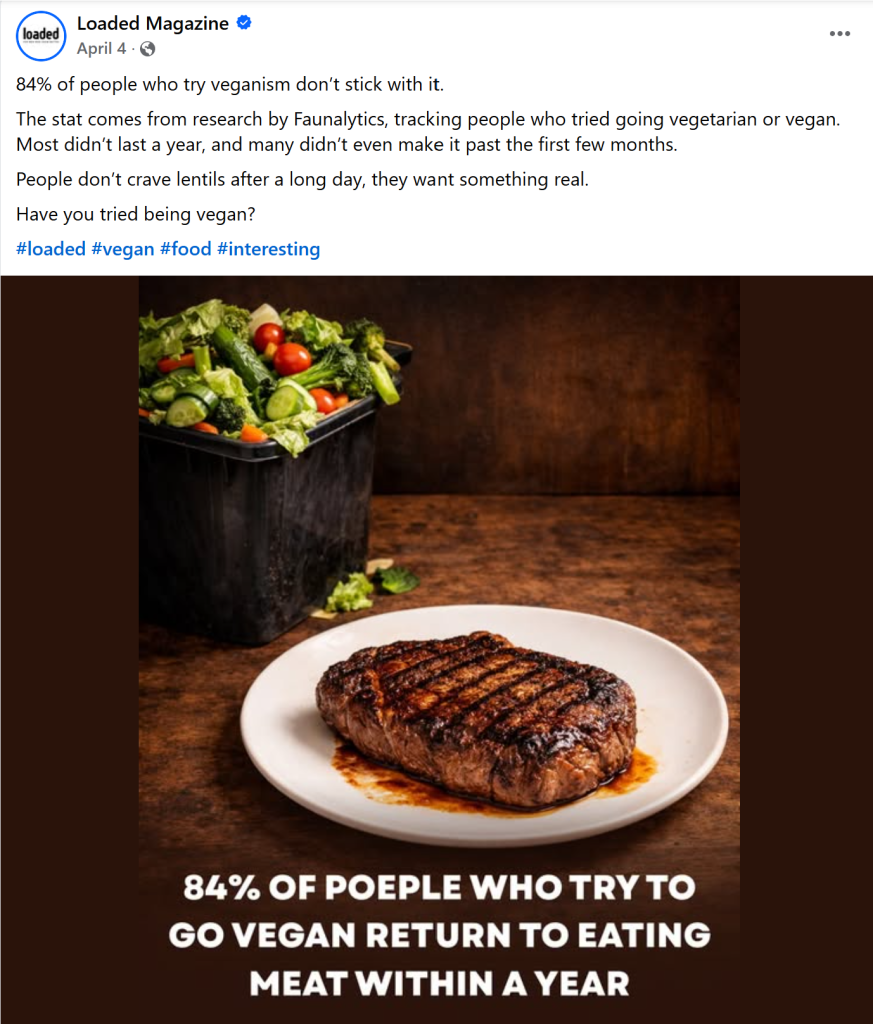
But we should aim to think critically. We don’t just take provocative headlines as cold truth without questioning.
If we look at the report of the original study, we find the following questions were used:
- Do you currently eat a vegetarian diet?
- Do you currently eat a vegan diet (one with no animal products?
- Have you ever eaten a vegetarian diet?
- Have you ever eaten a vegan diet?
These questions show the critical failures of this study.
The first failure is lumping vegetarians inside this study alongside vegans. The famous “84% quit rate” is actually a blended statistic. Because there are vastly more vegetarians than vegans, the high vegetarian quit rate drastically inflated the overall number. For example, my sister is a vegetarian strictly because she finds eating meat disgusting, but whenever I spoke with her about veganism she would immediately shut off and get defensive. Vegetarians like her were used a datapoint in this study, but this has no bearing on veganism whatsoever – vegetarians are simply non-vegans for all intents and purposes, and their avoidance of one particular aspect of animal exploitation has absolutely no bearing on the abolitionist principle of veganism.
The second failure is conflating a diet with a moral baseline.
The study doesn’t examine whether the respondents were actually vegan. It only asks if they ate a vegan diet. This is a crucial mistake. It captures people who ate plant-based for weight loss, health trends, or environmental curiosity. By lumping plant-based dieters together with ethical vegans, the study conflates a temporary consumer habit with a deeply held moral principle.
The third failure is asking people why they stopped. When respondents were asked why they abandoned their “vegan diet,” the answers revolved around convenience, cravings, and social pressure. This proves they were answering from a dietary perspective, which has no bearing on veganism.
Simply put, this study only proves that people who adopt a strict plant-based diet for any reason tend to eventually abandon that diet.
You can quit a diet. But you can’t ‘quit’ the realization that animals are not property to be used. And that is what veganism actually is.
“But wait, Asi!”, some people may respond at this point. “There are some people who weren’t just plant-based, they were even vegan activists! Protesting and uploading posts to social media, and they still quit!”.
That’s very true. But there is an explanation. Let’s dive into it:
The Dark Ego Vehicle Principle
How many times have non-vegans accused you of being vegan just to “feel morally superior”?
While that claim is usually pure projection (since non-vegans are the ones asserting absolute superiority over animals), it actually describes a real subset of high-profile activists.
The dark-ego-vehicle principle (DEVP) suggests that individuals with so-called dark personalities (e.g., high narcissistic traits) are attracted to political and social activism that they can repurpose to satisfy their specific ego-focused needs (e.g., signaling moral superiority and manipulating others) instead of achieving prosocial goals.
This was covered by George Martin in his YouTube channel Carnism Debunked:
Simply put, some narcissistic individuals adopt a moral stance, but not because they care about the cause, but because it serves as a vehicle to fulfill their psychological desires – such as control & social dominance.
Instead of being internally aligned with the philosophy, the narcissist is instead committed to the ego rewards the movement provides to him.
Veganism being a moral position that less than 1% of the population holds and so it allows the narcissist to claim moral superiority over 99% of people.
Betraying the animals these individuals claim to want to protect becomes inevitable. These individuals are not driven by justice, but by ego rewards.
And the ego rewards for being a fake vegan activist dry up eventually. That’s when these individuals pivot.
By renouncing veganism publicly, they instantly receive massive validation, views, and praise from non-vegans who love seeing a “sanctimonious vegan” brought low.
This explains why ex-vegan influencers rarely walk away quietly and instead they choose to be performative and create multiple long videos about why they’re never vegan anymore. There is some correlation between people who have a high social media follower count and narcissism – so there’s no wonder you’d start seeing the “ex-vegan bandwagon” effect among the influencers.
Note that I am not claiming most people who call themselves ex-vegan actually suffer from DEVP, since as we established most of them are merely ex-plant-based. DEVP applies to the narcissistic individuals.
This means that the vast majority of so-called “ex-vegans” falsely create a picture that veganism is not a strong principle, and that those who adopt it tend to not hold it for the rest of their lives.
But then there is another question: What about those who fall to none of these categories? People who weren’t displaying behaviors from the Dark Ego Vehicle Principle, but knew full well that veganism is about stopping to exploit animals?
“But if they were a TRUE vegan, they would never betray the animals!”, some vegans say. “So there is no such thing as an ex-vegan.”
In this post I want to contend this claim. This brings me to the following:
No True Scotsman Fallacy
When faced with someone who genuinely understood veganism and still walked away, many activists resort to a logical fallacy: The No True Scotsman.
This fallacy occurs when a person creates a generalization about a group, but because of existing counter-examples to the generalization, the person modifies the definition to dismiss the counter-example.
“All X are Y. Here is an X that is not Y. Well, no TRUE X would ever be Y!”
In the case of veganism:
- The Claim: “No vegan ever goes back to exploiting animals.”
- The Counterexample: “Alex was a committed vegan for five years and went back to eating meat.”
- The Fallacy: “Well, Alex was never a true vegan.”
To see why this logic fails, look at storytelling. Let me give you an example from Star Wars.

The Star Wars universe introduces Jedi knights – guardians of peace and justice in the universe.
The Jedi take on what is called the Jedi Code – a set of rules that embody discipline, self-control, and devotion to the light side of the Force.
Anakin Skywalker was recruited as a Jedi. But after meeting a girl named Padmé, his love became possessive and desperate, and in trying to save her – he aimed to gain control over life and death.
In the process, he was manipulated and ended up slaughtering Jedi knights and gave rise to the fascist Galactic Empire.
- The Claim: “Jedi Knights are pure, selfless guardians of peace who never succumb to dark emotions.”
- The Counterexample: Anakin Skywalker, a Jedi Knight, was corrupted.
- The Fallacy: “Ah, but Anakin was never a TRUE Jedi! Real Jedi don’t let their emotions rule them – his attachments prove he was just a Sith waiting to happen!”
By retroactively redefining what a “true” Jedi is to exclude Anakin, the speaker avoids admitting that Jedi are capable of falling to the dark side.
How does this relate to veganism?
Insisting that “no TRUE vegan ever goes back to exploiting animals”, dismisses the fact that humans, and even vegans, can be corrupted over time.
The claim that “there’s no such thing as an ex-vegan” stems from a hidden fear: that acknowledging people can abandon the abolitionist stance somehow weakens the principle of animal liberation.
I understand the sentiment. But the assumption behind this claim is simply wrong.
This doesn’t justify animal exploitation, it merely exposes a flawed premise. An ethical stance doesn’t lose its truth simply because someone walks away from it. To claim otherwise conflates the objective strength of a moral principle with the subjective stamina of fallible humans.
Jedi knights represent justice and peace. Does the fact that Anakin was corrupted to forsake these values, mean somehow that justice and peace aren’t formidable values? Of course not.
Winston Smith in the book 1984 fought for freedom of speech and intellectual independence. Does the fact that he was broken and brainwashed to the degree he betrayed his partner and ended up loving Big Brother mean these values hold little merit? Of course not.
In the same sense, even if some people have forsaken the principle that humans should live without exploiting other animals, that does mean that veganism is somehow dismissible? It certainly does not.
“You’re giving pop-culture examples to make your case, but Anakin was driven by supernatural premonitions of his wife’s early death and was manipulated by a Sith, and Winston was tortured psychologically and physically to submission! But it’s not as if ex-vegans were victims of such conditions!”
If an ethical principle remains just as objectively true and valid even when someone is coerced into abandoning it, then it absolutely must remain true even when someone abandons it for something far milder – like conforming to their non-vegan circles just to blend in. The actions of people adopting a value do not in any way dictate the truth of an ethical position. An ex-vegan walking away reflects on their own failing as a person, not whether non-human animals deserve freedom from human use.
The triviality of the ex-vegan’s reasons doesn’t disprove the analogies I made – it actually highlights just how frail human moral stamina can be.
The Takeaways
Honesty: As mediums of truth, we as vegan activists must be careful using fallacious reasoning. Admitting that people can understand a moral truth and still fail to live by it preserves our intellectual honesty and keeps the focus where it belongs: on the animals, not on human ego.
Long-Term Retention: If social isolation drive people of weak moral fiber to stay vegan, a possible solution is to offer communities. This serves more than merely a retention tool, but also allows to recruit vegans into activism much more easily.
Framing Veganism Correctly: When veganism is framed as an identity, then a single slip might make people feel they’re “not true vegans anymore”, leading them to give up entirely. Instead, framing veganism as a moral duty, means that even if someone falters, their obligation to not exploit non-human animals remains, and they should resume upholding it immediately. This isn’t merely intended to increase retention rate – it’s to focus on the undeniable right of non-human animals to be free.
Leave a Reply