
This guide is intended for independent activists interested in gaining practical tools to create maximum impact for defending animals exploited by humans.
The premise of this guide is that you fully understand what veganism is, as originally defined by Leslie Cross; that you align with the abolitionist approach (and have no intention of wasting resources on the exact opposite of animal liberation – promoting animal welfare); that you understand the psychological mechanisms preventing people from going vegan; and that you strive to create a profound impact that ripples outward through the people you reach (i.e. by having them become active too), rather than stopping with a single, one-time interaction.
To build a strong foundation, we must first define what the movement no longer needs more of. The following areas do not work against veganism, but the movement locally and globally is already flooded and saturated with them in a way that will not move the needle anymore:
- Lifestyle vlogs.
- Vegan recipes and cooking blogs.
- Product accessibility (food, clothing, and footwear).
- Messages promoting health/environment instead of justice for animals.
If you choose to incorporate these elements into your activism, ensure they make up a negligible percentage of it and serve solely as “bait” or a tactical tool to expose the audience to the real, hard-hitting message.
The activism the movement needs right now is based on three clear elements:
- Uncompromising message: Absolute focus on the demand to end exploitation and immediately transition to veganism. This maximizes the chances of a person stopping their exploitation of animals and going vegan and speaking up for the animals.
- Broad exposure: Reaching the highest possible number of people.
- Domino effect: Creating new activists who will pass the message on and replicate the impact.
Before we dive into choosing the type of activism and its geographical location, you must first understand what resources and means are available to you to harness for the struggle.
The Four Levers
Since each of us goes through a different life path and is at a different stage, the resources available to you to help animals depend heavily on your life circumstances.
A 16-year-old from Tel-Aviv, who possesses video editing skills and plenty of free time after school hours, will operate in a completely different way than a 35-year-old teacher who holds a full-time job and is simultaneously active in prominent vegan organizations in Israel.
You have four levers at your disposal that you can harness for the animals:
- Skills
- Time
- Money
- Connections
Let’s expand on them:
1. Skills
Acting skills, illustration, graphic design, video editing, filmmaking, screenwriting, music, copywriting, management, programming, law, web development, public speaking, psychological understanding, and more.
All of these are skills that can be channeled directly to help animals. Whether you acquired them as part of your profession or as a hobby, they can serve as a powerful tool that is currently lacking in the movement.
But remember that certain skills can – and should – be learned specifically for this purpose. For example, video editing and social media management are critical tools for spreading the abolitionist message to the maximum number of people, regardless of the specific field you choose to operate in. Personally, even though my profession is in computers, I learned video editing and public speaking with the explicit goal of leveraging my activism with them.
2. Time
Ask yourself – how many hours a month do animals deserve for me to put in for their liberation?
It is important to be honest about the time you actively and purposefully put in. Spontaneous hallway conversations with colleagues at work should not be considered a defined time investment, as you cannot reliably and controllably schedule them into your routine. The same applies to conversations about veganism with friends and family.
Instead, define clear goals, such as:
- How many hours of outreach (field activity) are you willing to put in per month?
- At what hours of the day will you clear out time to edit videos of your activism to distribute them on social networks?
- On which days of the year will you invest time to join concentrated campaigns of large activist groups (for example, MajorActions.com)?
- When do you clear out time to learn a new skill that will serve the struggle (like video editing or working with Canva)?
Crucial Note: Your time is your most precious resource. Do not waste it on types of activism that you do not see yourself doing in the long term – this is a surefire recipe for quick burnout.
3. Money
I want the following to be absolutely unmistakable: donating money for animals makes you an activist in every sense. For the money you donate, you were required to invest precious time, skills, and energy at your workplace. There is no reason not to consider smart financial support an integral part of your activism.
You can answer the question of how much money to donate each month in a similar way to the question about time: How many hours of work per month am I willing to donate for the animals?
Not all readers are in a financial position that allows them to donate, such as high school or university students. But if you have a steady source of income, I highly recommend directing a portion of it to activists or organizations that will use your money in the most effective way.
- My Patreon: Since this is my website, I will, of course, mention that I have a Patreon, which is a platform that allows you to donate a fixed monthly amount to my activism. Since I cover my personal living expenses out of my own pocket, I can assure you that I will use 100% of your donation to promote and distribute the abolitionist content I produce. You are welcome to see more details in the attached link.
- Anonymous for the Voiceless (AV): Another organization to which I have personally donated thousands of euros is Anonymous for the Voiceless, or AV for short. I have been active in this organization for years, and together with thousands of activists around the world, we conduct sharp, on-the-ground vegan outreach and are uncompromisingly committed to moving people toward veganism. You can donate to AV in the attached link.
Beyond donations, keep in mind that running ongoing independent activism requires money: purchasing photo and recording equipment, data storage services, printing signs or stickers, travel expenses, etc.
4. Connections
Finally, your social and professional capital both within and outside the animal rights movement can serve as a powerful engine for change.
Examples of using connections outside the movement:
- Your brother is a lawyer and can provide pro bono legal counsel to vegan activists who encounter issues during their street oureach.
- You are a student in your local university and are connected to the management, allowing you to push for bringing in an abolitionist lecturer to give a sharp, hard-hitting talk to all the academy’s students.
- A close friend of yours works for a local newspaper or news website. You can connect them with a prominent activist to create an in-depth piece on veganism or field activism.
- Your roommate has a professional recording studio. You can offer activists the use of their space to record a high-quality outreach podcast.
Examples of using connections within the movement:
- You are a regular volunteer for organizations like WTF or AV, and you leverage your status or personal connection with decision-makers to influence the nature of projects or steer them toward more abolitionist lines.
- You personally know the social media managers of large organizations and use this to push for the distribution of sharp outreach videos you filmed on their high-exposure pages.
- You invite an activist from abroad to stay at your apartment to enable them to conduct a series of field activities in your city without accommodation costs.
- You are friends with a prominent activist and notice that they tend to focus their outreach on animal cruelty, so you suggest to them: “Instead of making cruelty the center of the conversation, have you tried talking about exploitation instead? To tackle the exploitative mentality of non-vegans at its very root?”
I’d love to share a personal story of mine where I used connections within the movement:
In 2017, I started following an Australian activist on YouTube who was doing field outreach in Melbourne. He had fewer than 2,000 subscribers on his channel at the time. A few months later, I added him on Facebook, and to my surprise, he accepted the request.
Later that year, because I was active in the Israeli organization Animals Now and also active in Vegan Friendly (another Israeli organization), I was invited to an event aimed at promoting the largest animal rights march in the world. There were laptops set up where activists who arrived logged into their Facebook accounts to invite relevant people from their friends list.
As I was going through mine, the Australian activist’s name popped up in my friends list.
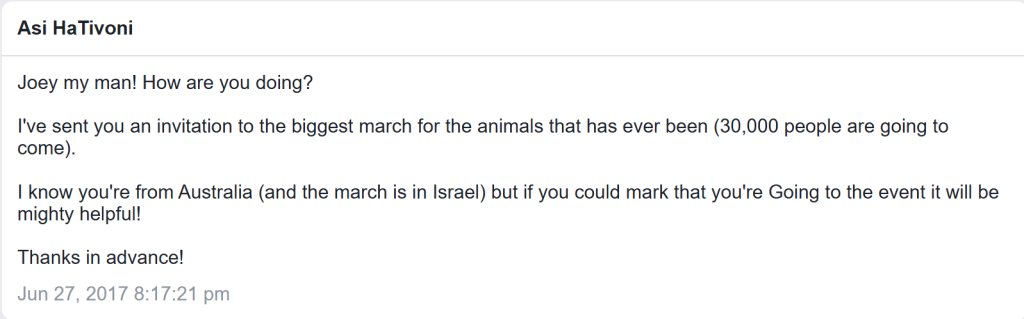
I didn’t actually think he would come, but two weeks later, I received a message from him saying he was coming – and that he had also invited Earthling Ed and James Aspey.




This activist’s name is Joey Carbstrong – now one of the most famous activists in the vegan movement. Following their visit to Israel, Joey published an outreach video filmed there that became the second most-viewed video on his channel, and Ed published a video of himself visiting an Israeli dairy farm. Both gained massive popularity and exposure after their visit.
As part of the domino effect, high-impact activists I met later down the line told me they went vegan because of them:
- Stefano, the regional organizer for AV in Italy, went vegan because of Joey’s videos and now publishes his own outreach content.
- Kristof, a prominent Hungarian activist who I randomly met in a vegan restaurant in Budapest, went vegan after watching the documentary video from the dairy farm that Earthling Ed uploaded.
And all of this happened because of the connections I held at the time and a single message sent to the right person.
In another story, when I arrived in Cologne, Germany, to join a month-long AV outreach campaign, I met the movement’s founder, Paul Bashir. Since he had been familiar with me and my activism for over a year, I approached him and pointed out a gap in our strategy:
“We are missing a tool that allows us to generate new activists. Just like we have a structured set of questions to transition non-vegans to veganism, we need a set of questions to transition passive vegans into active advocates.”
He agreed, and within just a few weeks, he created what is now known as the “Flowchart for Vegans“.

Before we choose the exact type of activism, we must map out the spaces and arenas in which we can operate. The most central arena today, without which your impact will remain limited, is social media.
Social Media
In the modern world we live in, the digital space has become the center of gravity for the social arena. More than half of the youth in Israel spend between two to six hours a day on their phones (according to a 2022 survey).
What this means for us as activists is crystal clear:
If you want to create maximum impact, you simply cannot afford not to operate on social media.
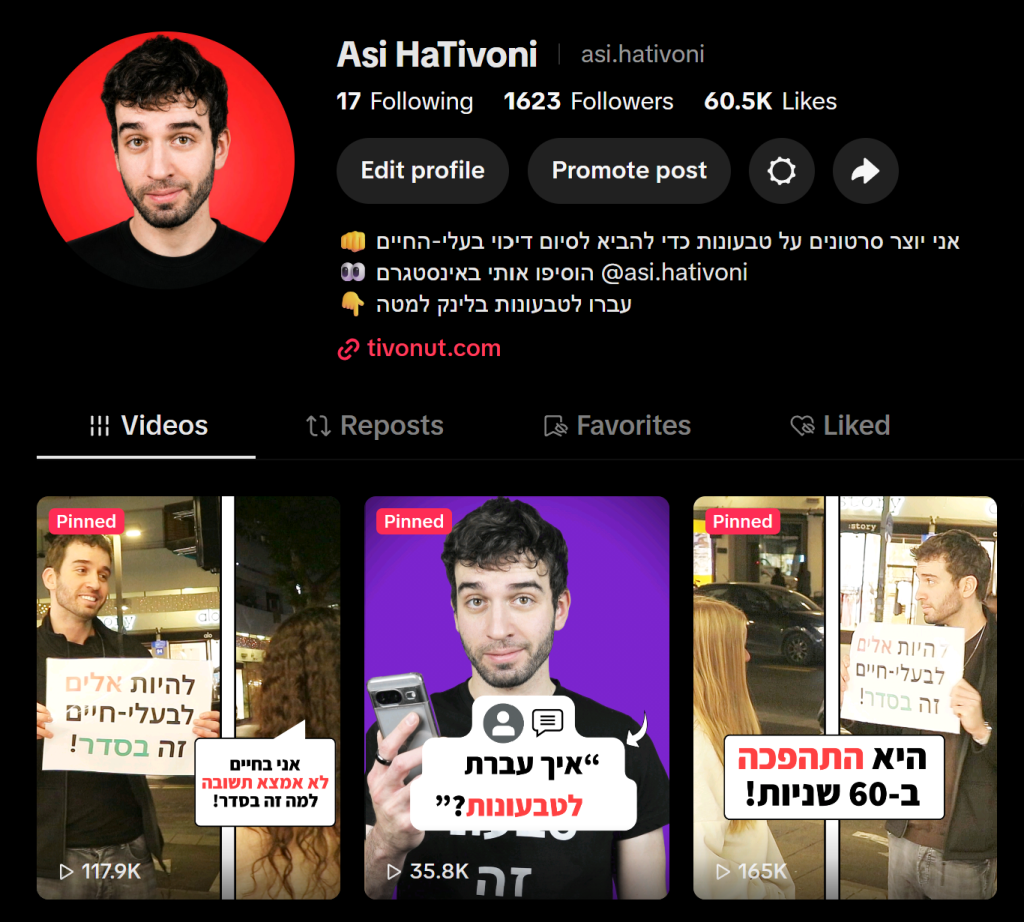
Every street activism or project you take part in must be accompanied by a digital distribution strategy.
Let’s say, for example, that you joined an AV “Cube of Truth” activity in Prague. You had a successful day and managed to inspire 6 people to go vegan on the spot. While that is a significant and important achievement, if you recorded your conversations and uploaded them to social media, those same 6 conversations could reach thousands, if not tens of thousands, of viewers! This is the maximum utilization of your time for the animals with relatively little effort. And the best part – even your “bad” conversations, where the other person didn’t end up going vegan, can achieve viral success online and inspire others to make the change.
As of the writing of this article, there are four primary platforms to focus on:
- Facebook: Mostly known for its groups, but you can also reach a wide audience using written content and short Reel videos.
- YouTube: The leading arena for consuming deeper, long-form content (full outreach videos, podcasts, or lectures). Alongside this, the platform offers rapid organic exposure to new audiences through YouTube Shorts, which are naturally similar to Reels on other platforms.
- Instagram: The most popular and versatile platform today. It is an incredible tool for creating collaborations with other activists using the Collaborations feature, sharing stories, and reposting. It also allows for easy distribution of written content via Carousels, and of course, serves as a powerful tool for sharing Reels capable of reaching thousands of people.
- TikTok: The most powerful algorithm today for launching new creators, even without a large follower count. Proper use of short viral videos and live streams (LIVE) from the field allows you to harness the algorithm to your advantage and reach a massive non-vegan audience directly. This is the platform you can leverage most significantly – if you’re not on TikTok, you don’t exist.
Note: Other platforms like LinkedIn, Twitch, and others can serve as additional tools to reach specific audiences, but the movement’s experience on these platforms is currently limited.
Remember: Even if you just film your face and talk about veganism for 30 seconds, that video can shake up a person’s entire world on the other side of the screen. Do not underestimate your power as an independent activist!
Beyond reaching a non-vegan audience, establishing your digital presence has immense internal value: once you generate exposure and impact, you build Social Proof within the vegan community. This status will allow you to forge strategic connections, influence decision-making in large organizations, and push the entire movement toward a more abolitionist and radical line.
Consistent success on social networks is also your ticket to mainstream media – television and radio. News channels and current affairs programs are always looking for figures who are already generating buzz and digital noise.
The history of the movement in Israel proves that television is an unprecedented force multiplier. When Tal Gilboa entered the “Big Brother” house in 2014 with an uncompromising abolitionist message, she held up a mirror to hundreds of thousands of viewers and sparked what became known as the “second wave of veganism” in Israel. Becoming a sharp and articulate content creator online is your way to pave the path to news interviews, studio panels, or popular reality shows. Following in the footsteps of Gary Yourofsky and Tal Gilboa, your digital presence today can turn you into the leaders of tomorrow’s change!
Not comfortable on camera? If you suffer from stage fright or prefer not to stand in front of the camera, you are not exempt from this arena! You can contribute your skills lever (photography, video editing, graphic design, or writing) to support other outreach activists in the movement. At the very least, you can comment on the videos of other abolitionist activists and help boost their distribution by giving them full watch time and sharing their content.
To learn about video editing for social media, you are welcome to check out AV’s guide on video editing found in the attached link.
Here are some guidelines about social media:
- Engagement as a Double-Edged Sword: Be careful about which posts you interact with. When you comment angrily on posts that promote animal exploitation, the algorithm interprets this as interest and boosts their exposure to thousands more people. Instead, push and comment on vegan and abolitionist posts to help them break through.
- Watch Your Phrasing: Platforms like Facebook and Instagram block and restrict exposure for aggressive language. Phrases like “I hope you end your life in a slaughterhouse” will get your account restricted. Furthermore, personal accusations that cannot be legally proven can expose you to defamation and libel lawsuits. Instead, focus on arguments, dismantling the exploitative mentality, and demanding accountability.
- Be Cautious with Criticizing Other Activists: While it is completely legitimate to open up discussions about tactics and strategy within the movement, if you publicly criticize a specific organization or individual in a distasteful manner, other activists will be hesitant to collaborate with you.
- Baseline Quality: A video doesn’t need a Hollywood production, but it must meet three baseline conditions: clear captions (since most people watch without sound), lighting that illuminates your face clearly, and clean audio free of background noise.
- Experiment Constantly: Try different content formats, video lengths, on-screen text, trending sounds, or different speaking styles. Variety will help you understand what works and what doesn’t.
- Take Inspiration from What Works: Follow famous abolitionist activists locally and abroad. Take video formats that went viral overseas and translate or adapt them for your local audience.
Now that we understand that the smart use of social media is a prerequisite for success, let’s move on to the complementary arena where it all begins – the public space.
Street Activism
I wholeheartedly believe that a vegan activist who does not engage in field activism is not realizing their full potential. While it makes complete sense to place your primary focus on social media distribution, physical street activism has distinct and unique advantages that simply cannot be achieved behind a screen:
- Meeting other activists: Beyond the obvious benefit of coping with the mental toll of living in a non-vegan world alongside people who understand exactly how you feel, street activism introduces you to important social circles. This is where you can learn from more experienced activists, teach others, and co-develop existing and new action methods.
- Immediate satisfaction: Try to imagine how you will feel when a non-vegan looks you straight in the eye, shakes your hand, and promises you that, thanks to the conversation you just had, they are stopping their exploitation of animals from this moment forward. This experience provides an insane boost to your motivation and energy that no online like or comment can ever match.
- Reality check: Many vegans engage in endless, non-stop debates online about what gets people vegan but don’t actually go out into the field or talk to a large number of real non-vegans on a regular basis. The authority to define which action method or tactic is truly effective belongs solely to those who actually conduct outreach conversations with a large number of people on the street and know what works and what collapses in real-time based on practical experience.
- Sharpening your outreach skills: Anyone who consistently shows up for street outreach gets to experiment with different advocacy methods, diverse phrasings, and varying body language to become a charismatic, sharp, and convincing activist. This activity gives you total control over managing the conversation, eliminates stutters and anxieties, and ultimately builds exact psychological awareness – both to maximize the chance that the person in front of you changes, and to know exactly which moments in the conversation will make an insane viral video online.
- Amplifying the domino effect: A video of you at home talking directly to the camera about animal exploitation can certainly go viral and have an impact, but it falls short compared to the domino effect generated by an outreach conversation. When viewers at home see you conducting a live interaction – for instance, in an AV Cube of Truth demonstration – they aren’t just listening to your arguments; they are watching the shift in consciousness happen in another non-vegan in real-time, and most importantly, they see you in action. This mirror gives them insane inspiration; it dismantles their fear of street outreach and shows them exactly how to do it right. Street outreach is the most powerful tool we have to get other vegans to step away from their screens, get out onto the street, and become activists themselves.
There are 3 different ways to perform field outreach that I can personally recommend:
1. Joining the AV “Cube of Truth” Demonstration
Anonymous for the Voiceless (AV for short) is the largest on-the-ground vegan outreach organization in the world, with over 10 years of experience talking to non-vegans.
Using a demonstration layout featuring Anonymous masks and TV screens showing footage from animal exploitation industries, non-vegans stop to look at the footage, and we conduct outreach conversations to move them toward veganism. If there is no chapter in your city, consider becoming an organizer yourself.
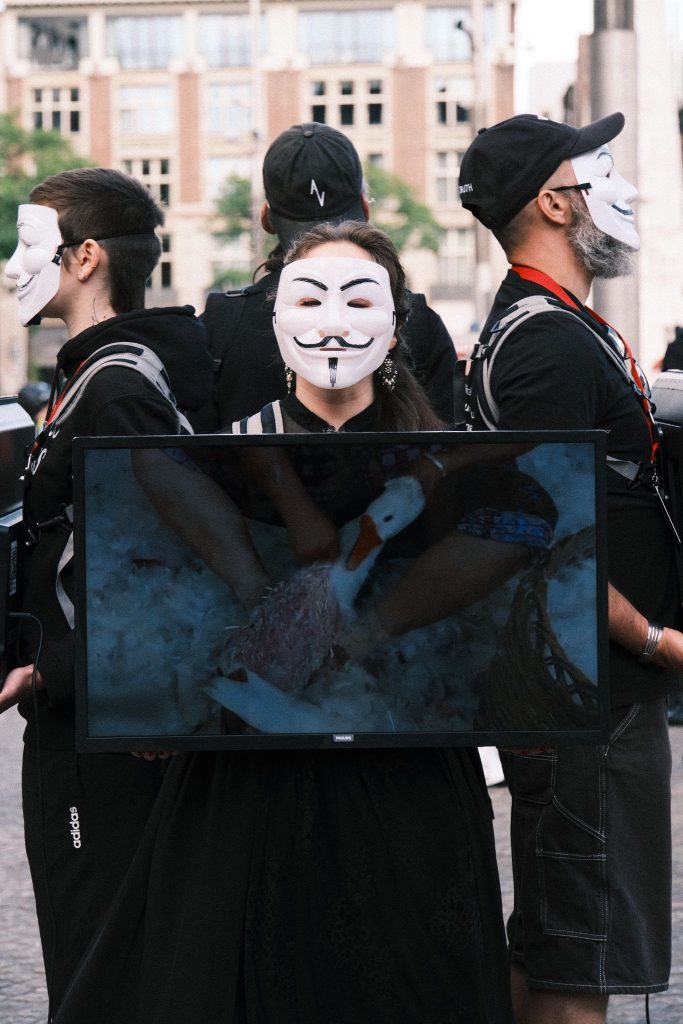
Prominent activists in AV have created a chain reaction through which people not only woke up to veganism, but also started becoming active and publishing outreach videos themselves:
- Laurie: The daughter of pig farmers, she brought veganism into the mainstream in France as one of the country’s sole prominent activists. The overwhelming majority of her content consists of outreach videos she records during AV events.
- Oliver: A German activist from Cologne who led Germany to become one of the countries with the highest number of AV chapters in the world.
- Stefano: An Italian activist and the regional organizer for AV Italy, which has enjoyed massive success. Non-vegan Italians who run into him outside of Italy constantly recognize him from his videos.
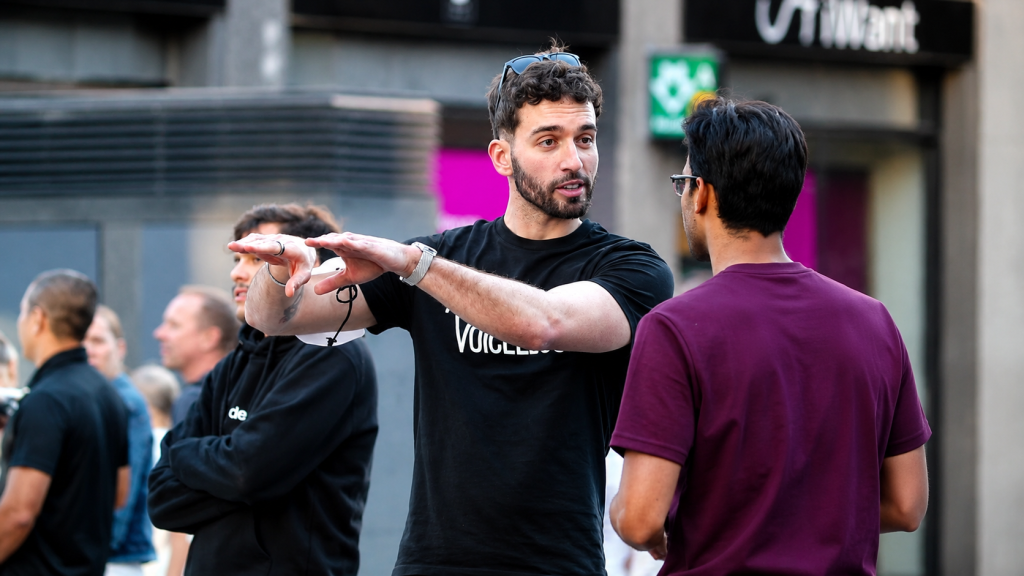
2. Joining NEON Protest
Similar to AV, the NEON protest promotes an abolitionist vegan message. However, instead of using video screens, activists hold signs with powerful images while techno music and speeches by prominent activists Gary Yourofsky and Tash Peterson play in the background.
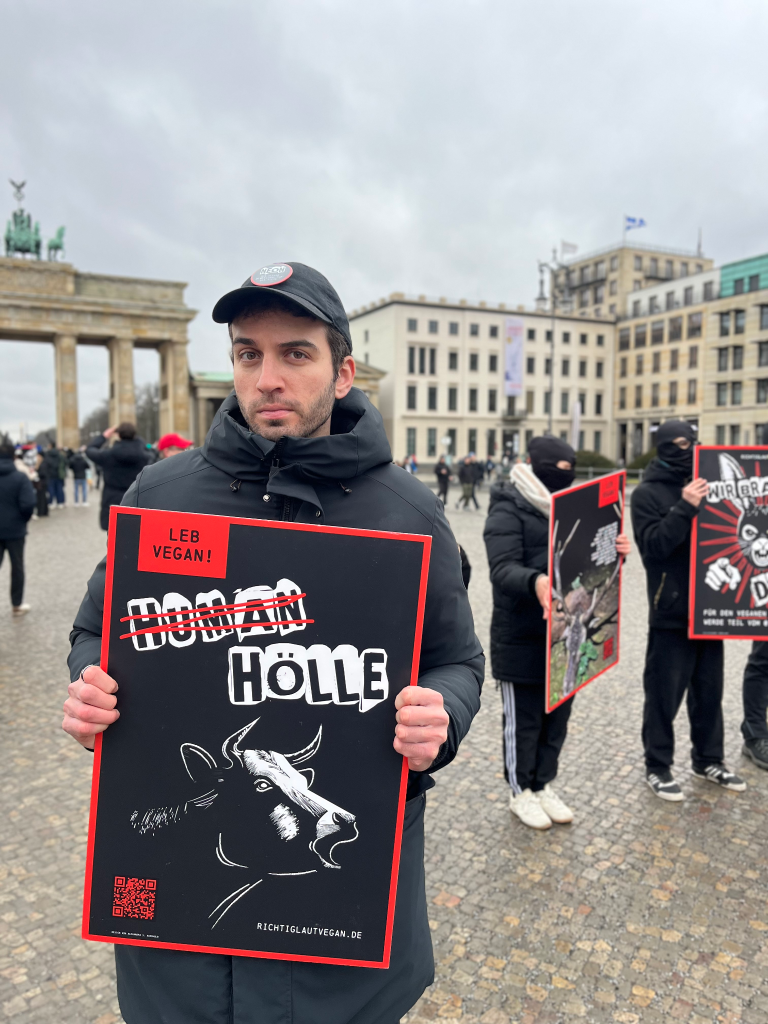
3. Solo Outreach
You don’t necessarily need to team up with other activists to be effective – you can head out onto the street completely on your own.
Prominent activists in the movement – such as Clif Grant, Chip, and Raffaela (The Militant Vegan) – use cameras they set up themselves or have a friend hold to film their activism. They engage in conversations with non-vegans right on the street, often while simply holding up a sign or a microphone.
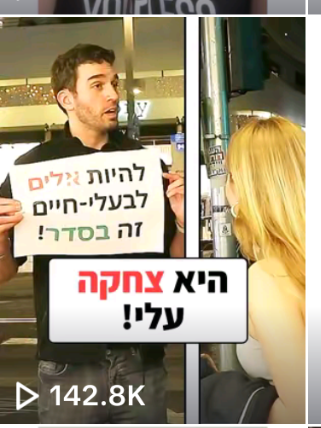
Sign reads “Being violent to animals is okay!”
Other activities that can be performed in the public space include:
- Chalking: Using chalk on sidewalks to write messages.
- Stickering: Putting up stickers.
- Protests: Participating in marches and demonstrations.
- Graffiti: Using street art to convey messages.
- Performance Displays: Participating in visual installations (for example, Speciesism.WTF).
How to do Vegan Outreach
Assuming you have read all the other articles I published on my website regarding vegan activism, the next step to learning how to conduct high-quality, abolitionist vegan outreach is by watching the outreach workshop by Anonymous for the Voiceless (AV for short).
As mentioned, AV is the world’s largest on-the-ground vegan outreach organization. With over a decade of experience experimenting with various advocacy methods, they are entirely committed to putting what actually works for the animals first. This unwavering commitment led to the development of the “AV Protocol.”
This protocol is a set of principles and key guidelines accompanied by a sequence of questions known as the Flowchart, specifically designed to maximize the chances of the person in front of you transitioning to veganism – assuming they are open to it.
The workshop, hosted by Paul Bashir (the founder of AV), details AV’s approach to vegan outreach alongside a thorough explanation of the protocol. It can be found in the attached link under Outreach Masterclass.
⚠️ Please note: If you wish to conduct outreach at an AV street activism event, watching this workshop beforehand is mandatory.
Written versions of the outreach protocol and the most up-to-date Flowcharts are also available in the attached link.
Let me emphasize this – do not start vegan outreach until you have finished watching the masterclass in its entirety. This is the absolute baseline required to ensure you have the correct tools to approach a conversation with a non-vegan. Head over to ACTIVISM101.COM and familiarize yourself with the latest outreach protocol.
You can also draw plenty of inspiration from the wide array of outreach videos uploaded daily to AV’s page via the attached link.
After you have finished studying these materials, there are a few specific points from my personal experience that I would love to share with you:
- Exploitation vs. Suffering
Within the movement, there are two main groups of outreach activists who place animals at the center (without distracting the conversation with health or environmental discourse).
In the first group, there are vegan activists who focus their outreach on the suffering and pain that animals endure.
The line of thinking here relies on the fact that people do not want to be viewed as animal abusers or cruel. Emotionally, they react very strongly to animal suffering, which increases their aversion to wanting to continue demanding that animals be exploited so violently for things like meat, dairy, leather, etc. This style of outreach tends to be highly popular and reaches a larger audience due to its heavy emotional impact.
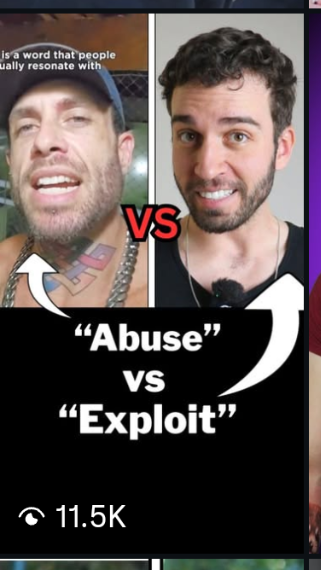
James Aspey, a prominent Australian vegan activist of the previous decade, leans toward this group and has explained in the past why he believes discussing abuse/cruelty is more effective. You can watch my response video to him in the attached link.
Conversely, vegans who focus their outreach around exploitation have internalized that once the emotional shock of watching a video of animal suffering fades, the person will eventually rationalize continuing to exploit animals, sooner or later. Even if they are convinced to stop participating in the symptoms of exploitation, they still perceive animals as resources. Therefore, we must uproot the problem from its core – and talk about the exploitation itself. This is the only way to completely dismantle the oppressive mentality that non-vegans hold toward animals.
As abolitionist activists, we must focus the conversation around exploitation. At the same time, we must be careful: discourse surrounding exploitation alone can sound dry, overly logical, or abstract, thereby failing to convince individuals or reach a wide audience.
The answer lies in combining the two. Using videos that show individual animals in heart-wrenching situations, or a raw description of a calf being separated from his mother and taken to slaughter, can serve as an emotional entry point. Through this crack, we can inject the true abolitionist message – that animals are not here for us, and it is time to stop exploiting them as resources.
By doing this, we keep the focus of the discourse on exploitation – ensuring we address the problem at its roots – while simultaneously incorporating elements of suffering-based advocacy to guarantee we successfully connect the non-vegan emotionally with their victims.
Further Reading: Ben Mazaza, a prominent Canadian AV activist in the movement who is a major source of inspiration for me and my vegan outreach philosophy, wrote about this topic in the attached article.
- Debate vs. Outreach Conversation
In a debate, your goal is to defeat your opponent with stronger arguments. A debate is an excellent tool when you have an audience watching you. But in the abolitionist movement, the phrase “Justice is not up for debate” is common, which aims to make it clear that the fundamental rights of animals to live freely are not a subject for negotiation.
However, there is a difference between this statement and the claim that veganism itself is not a topic for debate. Anything can be a topic for debate. It doesn’t legitimize a position, no matter how absurd, just because it is brought up in a debate. To use an example unrelated to veganism, the YouTuber Destiny did a debate on pedophilia a few years ago. Within our movement, the famous activist Earthling Ed grew in popularity and managed to convince many people to go vegan precisely due to the debates he conducted.
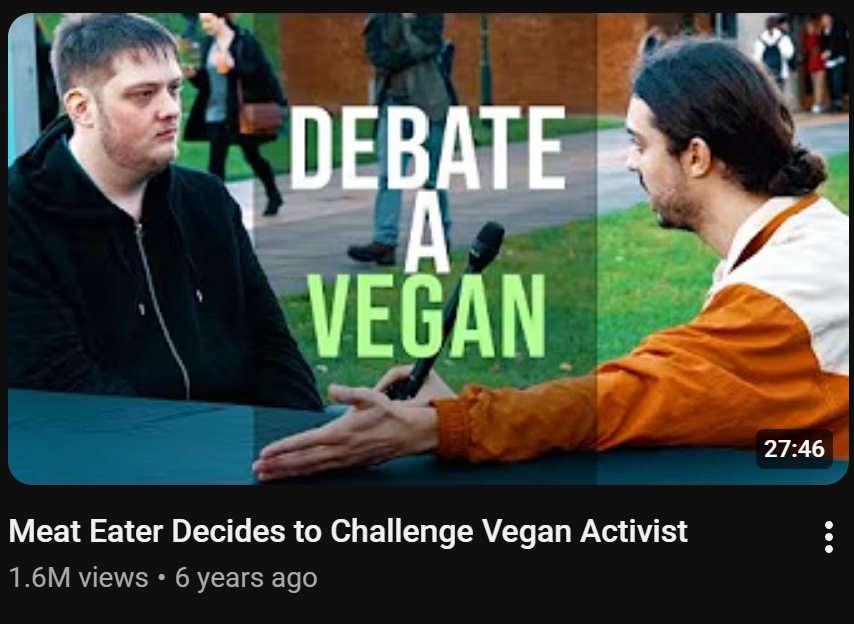
If you are invited to a news channel for a discourse on veganism, and the other person hosted on the panel is a hunter, you are definitely not doing the animals any favors if you refuse to appear just because “justice is not up for debate.”
Debating is a powerful tool that allows us to bring animals into the center of the mainstream discourse, and people absolutely can go vegan because of it (for example, That Chip Guy, who shared that he transitioned to veganism from watching debates).
The real question is what you are trying to achieve. While winning a debate is effective for convincing a viewing audience, it minimizes the chance that the specific person standing right in front of you will be convinced to almost zero.
While Earthling Ed is considered the most famous vegan activist in the world (as of the writing of this article), his outreach method – which focuses heavily on logic, facts, statistics, and debating – is not an effective tool for convincing the individual standing right in front of him to go vegan. The German activist Oliver expands on this in the attached video.
If the goal is for the person in front of you to go vegan, you must create a unique dynamic: a dynamic of demanding accountability.
- This is not the dynamic of opponents in a debate.
- This is not a friendly, casual dynamic.
- This is not a sales dynamic.
- This is not a psychologist-patient dynamic.
This is the dynamic that occurs, for example, when you have hurt your partner’s feelings, and they demand that you take responsibility and apologize. The offending party must acknowledge the wrong, internalize its severity, and promise not to repeat the action.
Compassion without honesty is manipulation.
When you play nice with a non-vegan, shifting the discourse to the health benefits of a plant-based diet instead of focusing on the victims, or when you negotiate at the expense of the victims (“reducing your consumption is also good,” “just make a gradual transition”), you are not being honest. This is because all parties know, at least subconsciously, that exploitation must be stopped completely, and that there is no real barrier preventing them from committing to it right this very moment.
You must be honest with them. They need to understand their personal responsibility, the fact that their daily decisions create helpless victims who never gave consent, and that they need to go vegan as a baseline moral minimum.
But always remember the other side of the coin: while compassion without honesty is manipulation, truth without compassion is cruelty. And this leads us to the next point:
- “They do not want to be oppressors”
I learned this line from Andreas, an awesome Norwegian AV activist. Before you approach anyone to talk about veganism, recite this to yourself in your head:
“This person does not want to be an oppressor.”
You need to give people the benefit of the doubt. You were also a non-vegan once, and I am sure you would have been glad if someone put their absolute best effort into helping you reconnect with animals as soon as possible – firmly and directly, yet patiently.
You need to assume that they are in this exact position, so lead the conversation with a compassionate tone and with patience. You need to tell the whole truth – do not hide it from them or sugarcoat it. But present it with an approach of: “I know that being an animal oppressor is not the person you want to be.”
The moment you exhibit frustration, contempt, disrespect, or anger, the conversation is most likely over. It will be rare for the other person to remain open to speaking with you honestly and with integrity if you do so.
The mentality here is one of a “self-fulfilling prophecy” – in a psychological sense, not a mystical one. It stems from the understanding that if the other person has honesty and integrity, and you put your best efforts into drawing those qualities out, that is exactly what will happen.
Please note: Mirroring reality is not being forceful or imposing. If you show someone the contradiction between their values and their actions, and tell them that the moment they go vegan they will stop being a hypocrite – that is simply defining objective reality. If they get upset, it is because reality (“you are exploiting animals”) is hitting them, not because you insulted them (“you are a bad person”).
It is crucial that you put truth first, because the other person deserves to hear the truth and that is what the animals need. The truth should be wrapped in compassion, because you don’t want to trigger the other person’s ego unnecessarily. However, remember that if the other person proves not to be open, you must choose truth, even if it comes at the expense of compassion.
Which leads us to the next point:
- Most People Aren’t Open to Go Vegan (and How to Respond to It)
It is easy to mistakenly think there is a paradox between the previous point and this one. Didn’t we just say that the other person “does not want to be an oppressor”?
Absolutely. But we are going to approach this with a clear mindset: everyone is innocent until proven guilty.
In the article “5 Reasons Why People Aren’t Vegan“, I explained that one of the core reasons is a lack of accountability, and that accountability requires both awareness and agency. In a vegan outreach conversation, we aim to awaken both of these elements.
But what happens when a person has awareness and agency, yet decides to continue exploiting their victims anyway (due to the other reasons mentioned in the article, such as ego preservation, conformity, or an exploitative mentality)? Or what happens when a person chooses to evade responsibility and deflect blame with phrases like “society is to blame, not me,” “it won’t make a difference if I go vegan,” “I don’t exploit animals,” or simply starts physically walking away from you without listening to what you have to say?
To the misfortune of the animals, you will quickly discover that this will be the case with most people you talk to, no matter how much you love that person or consider them a good human being.
When the person in front of you gives you sufficient proof that they intend to continue exploiting animals – whether they refuse to acknowledge the contradiction between their claim that animals deserve freedom and their actual actions, or they agree in principle with everything you say but refuse to change – they have lost the benefit of the doubt you granted them at the beginning of the conversation.
Identifying a Closed Mind
One way to identify whether the other person is truly open to change is by using the “3 strikes and you’re out” policy as described in the AV protocol, or by judging their tone. If they are aggressive, acting defensive, insulting you, using manipulation tactics, or simply treating everything you say with utter indifference, chances are they are not open.
Another sign of closed-mindedness is when, early in the conversation, the non-vegan starts over-philosophizing unnecessarily, contradicting your every word, shifting the subject, evades your questions, or trying to drag you into a rigid debate.
In this scenario, assuming you started the outreach conversation to convince them to go vegan and not to score points in a debate, you must proactively end the conversation from your end, deliver a final statement, and physically walk away. (Leaving is critical to allow your words to sink in and do their work).
Managing the Layer of Compassion
While you must always put the truth first, you have two options when it comes to the outer shell of compassion when a conversation goes south:
Option A: Shed it completely
You stop acting polite and prepare to deliver a piercing statement to the other person as a final attempt to demand accountability and shock their consciousness:
- “May life treat you the way you treat other animals.”
- “At the end of the day, you choose to be an oppressive and violent person toward helpless animals.”
- “Every day you are not vegan, you are the direct reason why animals are exploited to death.”
The level of contempt in your tone can be greater if the other person dismissed you with blatant apathy. Note that if you choose this path and intend to upload this conversation to social media, make sure you are not lashing out in rage and anger, but rather speaking in a cold, serious tone of disappointment. Viewers at home must see that your motive is protecting the victims, not feeding your own angry ego.
Option B: Retain it
The intention here is not to play nice (like saying “thanks for your time,” “have a nice day,” or making any other attempt to end the conversation on a falsely positive note – these shouldn’t happen!). The intention is to firmly convey the message:
“We both know your choice right now does not reflect who you are or who you want to be. I know you will be vegan, and it’s important that you know it too. You know better than this.”
You can walk away with a statement like: “Don’t let your ego be bigger than your heart. We both know you don’t want to be a violent oppressor toward animals.”
Note: If the non-vegan exhibited utter indifference or blatant cruelty toward animals, I do not believe this second option is the one you should choose.
Now that we have discussed the approaches of truth and compassion in vegan outreach, we can move on to additional scenarios you will encounter in outreach conversations. The first scenario is when you encounter trolls.
- Conversations with Trolls
A troll is a person who intentionally behaves in a despicable manner to provoke a reaction from you as an activist. For example, someone who buys a beef burger from Burger King and eats it right in front of activists during an AV outreach activity. Someone who laughs and says, “I enjoy it,” when you ask them, “How do you feel about the exploitation of animals?” Or someone who stands to the side with their friends in front of your demonstration, pointing at the graphic images and laughing.
Let’s start with the one thing you must never give them under any circumstances – the satisfaction they are looking for.
Trolls want to provoke. They feed on your reaction. They are filled with joy when you get upset, yell, or complain. They want you to be left with a sense of despair as a result of interacting with them. If you give them the satisfaction they crave, they win, and you will be left with emotional burnout and anger that will bleed into your next interactions.
You have two options for action:
Option A: Complete Disregard
This is AV’s default approach. We completely avoid engaging with trolls because, in all probability, there is zero chance they will go vegan. Instead, we move on and wait for someone else to stop and talk to, as their chances of going vegan are much higher. Not only do we not speak to them, we even avoid making eye contact.
I understand this line of thinking, and for most activists, it really is the safest and preferred option. However, it is important to remember one thing – troll behavior is often the result of the ego trying to protect itself, and it does so through mockery. It is a defense mechanism. And sometimes, this defense mechanism can be neutralized.
And another point that we have to keep in mind, if you are being filmed, an interaction with a troll can lead to way better engagement in social media, assuming you manage to run it very professionally.
Which leads us to the second option.
Option B: Neutralizing the Defense Mechanism
To pull this off, you must project zero anger and absolute seriousness. In a quiet, cold (and perhaps even curious) tone, you can use one of the following phrases:
- “Does violence against animals genuinely amuse you?”
- “Do you really find animal abuse funny?”
- “Yeah, hilarious. Did you come here to troll me, or are you capable of having a mature conversation?”
- “Do you have the courage to look at what we’re showing here for just 10 seconds?”
Their immediate reaction will tell you if there is anyone worth talking to. If they continue to mock you, disengage from the conversation immediately. But there is a chance that, due to your seriousness and calm, their mask will fall, their facial expression will change, and they will give you a serious answer – thereby shifting the troll out of a foolish defensive stance and into a deep, meaningful conversation.
But trolls are not the only obstacle we face. Real-life interactions are complex, spontaneous, and include elements completely beyond our control. One of these elements is the presence of other people during an outreach conversation.
What do we do when we encounter a group of people?
- Conversations with a Group
Couples, trios of friends, or families – throughout your life as an activist, you will encounter diverse human configurations. You must adopt the right strategy to manage them.
Let’s start with the optimal scenario: You come across a group of non-vegans. Everyone is attentive. Everyone expresses interest. Everyone agrees with you. Everyone agrees to go vegan together.
Such situations do happen. It is possible. But most of the time, this is not the case. When you face a group, you must map it out quickly based on two variables:
- Who is the dominant person who tends to answer?
- Who is actually open to listening and going vegan?
These two things are not the same, and in many cases, they conflict with each other.
To illustrate my point, imagine the following situation: You approach a couple and ask them, “How do you feel when humans exploit animals?” From that point onward, only the boyfriend answers every question. He makes excuses, shows hesitation, and constantly contradicts himself.
The girlfriend is completely quiet, but she listens intently to everything you say. She gives her boyfriend a strange look when he says “plants have feelings,” but nods in understanding when you speak.
You realize that the boyfriend is not open, so you turn to the girlfriend and direct the conversation to her. She shakes your hand when you ask her, “So, vegan from now on?”
Two Steps to Managing Groups Effectively
- Engage everyone from the beginning: This is what I call the “Round-Robin” approach. In your opening questions, make sure you get an answer from each person present. You need to ensure that anyone who is open to going vegan is participating in the conversation and answering your questions. Anyone who steps aside to look at their phone becomes irrelevant.
- Focus on the open individual: A group of non-vegans is made up of individuals; do not treat the group as a single monolith. When you recognize that one member of the group is not open, make a conscious choice to focus on the person who is. Sometimes you will need to state this explicitly: “I’m talking to you right now, not your friend,” and completely ignore the person who clearly will not change.
An immense added value of this tactic is reverse peer pressure. The moment the open person in the group takes accountability and declares they are going vegan, the chances that their friends will be influenced and join them skyrocket dramatically. If you had wasted your time arguing with the closed-minded individual, you would have lost both of them.
Neutralizing Distractions and Pull-Aways
Frequently, the closed-minded person will try to physically pull the attentive listener out of the conversation (“Come on, we have to go,” “Forget it, it’s a waste of time”).
In such a situation, look directly at the attentive person and address the elephant in the room with a sharp question that neutralizes the disrupter:
- “Is he the one controlling you?”
- “Does he make decisions for you?”
- “Does he speak for you?”
These phrases restore agency and autonomy to the person in front of you. They will often cause them to stay and give you their full attention, while the disrupter is left embarrassed and neutralized.
⚠️ Please note: Once you decide to ignore one of the group members and focus on the one who is open, you must commit to it. The disruptive person will try to insert themselves back into the conversation to regain control. But since you have already determined they are not open, you must ignore them no matter what they say. In the attached video, Oliver demonstrates how to do this.
- Getting a Declaration
After you have spoken with a non-vegan, established that they want to respect animals but are living in contradiction by exploiting them (and are therefore being hypocritical), and verified that there is nothing truly substantial preventing them from going vegan, the call to action to transition to veganism on the spot is incredibly important. This is standard practice in the AV outreach protocol.
The conversation reaches a crescendo at this exact moment because, while they might have agreed with you up until this point, the next step requires an actual change on their part. Talk is cheap, but what truly matters are actual actions.
After all, as far as the animals are concerned, there is absolutely no difference between a non-vegan who agrees with you on everything yet refuses to change, and a non-vegan who says, “All animals can burn alive for all I care.” To the victims, both are violent oppressors.
When you pose the decisive question – “So, vegan from now on?” – there is a high probability you won’t immediately get a strong, honest declaration, but rather evasion attempts along the lines of “I’ll try,” “I’ll think about it,” or “I’ll reduce.”
It is crucial that you continue to demand that they take accountability. You both know very well that they can stop exploiting animals right this very moment. To dismantle these half-answers, you have several options:
- The Victim’s Perspective: “If you were in the position of your victims, would you want your abuser to ‘try’ to stop exploiting you, or would you want them to decide to free you right this very moment?” Wait for their answer, and after they agree, return to the original question: “So, vegan from now on?”
- The Non-Vegan World: “The moment you step back into the non-vegan world, the people around you will comfort you and validate your decision to exploit animals. This means the best time to make this decision isn’t when you return to that environment, but right here and now, while your heart is open and you are seeing the truth right in front of your eyes. So, vegan from now on?”
- Heart vs. Ego: “What is bigger in you right now – your heart or your ego?” If they answer “the heart,” follow up immediately: “Are you willing to show that in your actions?” and if the response is positive: “So, vegan from now on?”
- The Summary: “Let’s review what we talked about. We agreed that you want to respect animals, but you are living in hypocrisy and contradiction by exploiting them. We agreed that there is nothing substantial preventing you from stopping the exploitation of animals right this second and becoming vegan. So, what decision are you making right now?”
- Surfacing the Hesitation: It is possible they haven’t told you what is truly holding them back from going vegan. “I feel like you are hesitating to commit to going vegan. What is the reason for that?”
- The Real Reasons: Directly address the elephant in the room – the real reasons they remain non-vegan (as I detailed in the attached link). “At this stage, after agreeing on everything, there can only be 3 reasons why you wouldn’t agree to go vegan despite acknowledging it’s the right thing to do.” Based on your conversation with them so far, elaborate on 3 out of the following: an exploitative mentality, lack of accountability, conformity, or ego preservation. Check with them which of these factors applies to them. In the article about the 5 reasons, I wrote about how to address these reasons if they are relevant. This option has been a game-changer for me and managed to help me get declarations when the situation seemed hopeless.
The Three-Strikes Rule
After two or three focused attempts where you have tried to lead the person to take accountability and they still insist on making excuses, evading, or showing indifference – it is time to proactively end the conversation (as detailed in the previous section) and walk away.
At this stage, there is nothing more you can say that will change their mind; the person has simply made a conscious choice to put their personal convenience and ego before justice, compassion, and basic moral integrity. Do not waste a single extra ounce of energy on them.
The conversation needs not to end on a positive note if they decided to continue to exploit animals. I don’t say “thank you” or even “goodbye”. At most I give them a nod. Refer to the “Most People Aren’t Open to Go Vegan” section for possible ways to end the conversation.
Take a breath, reset, and prepare for the next person waiting for you.
- Choose the Correct Words
It is important that we change the way the discourse around animals is conducted today, both within the vegan movement and outside of it. While we have no control over the words non-vegans use, we can choose to stop framing veganism as a matter of diet and start framing it as an issue of justice.
- Ditch “Meat-Eaters” / “Omnivores”: A simple example is to stop calling non-vegans “meat-eaters” or “omnivores.” This reduces the discourse to a matter of diet or physiology around one very specific practice – eating animals. Furthermore, these terms fail to include vegetarians, who are also responsible for the exploitation of animals. Just call everyone “non-vegans” and leave it at that.
- Change Your Emojis: Stop using the 🌱 emoji to represent veganism, because veganism is not about plants. Instead, use the emoji that represents justice: ⚖️.
- Ban “Trying Veganism”: “Trying veganism” needs to be eliminated and never be said from your side. There is no such thing as “trying” a moral principle. Either someone chooses to adopt it and stops viewing animals as resources, or they don’t.
Vocabulary Shifts
To prevent reducing the discourse to utilitarianism, welfare, or an over-focus on a specific symptom of exploitation – and to stop people from shifting the blame to an external factor – be very careful about overusing the following concepts:
- Harm
- Abuse
- Suffering
- Violence
- “The Industries”
- Paying for animal products
- Murder / Killing animals
The integration of these concepts into a vegan outreach conversation must be done carefully. As mentioned previously, they can serve as an emotional entry point, but they should not constitute the essence of the conversation. The dialogue must always return to exploitation, not abuse, suffering, or killing. In most of my outreach conversations within AV, I don’t use those words at all.
❌ Also, avoid framing veganism as:
- Something that “saves” animals (this is not a good deed, it is simply basic decency)
- Reducing harm to animals
- Reducing suffering “as much as possible”
- A boycott of the industries
✅ Instead, use the following words:
- Freedom
- Respect
- Oppression
- Use
- Exploitation
- Injustice
- Atrocity
- Demanding (Demanding animal exploitation)
- You are responsible for… (animal exploitation)
- Because of you
- For you
- Your victims
Closing Statement
This guide was not written to be added to another pile of digital files on your phone. It was written out of an existential urgency – an urgency that only those who look reality in the eye and understand the absolute severity of animal exploitation are capable of feeling.
Our starting point was clear: the animal liberation movement does not need more recipes for cashew cheese. The movement needs sharp, skilled, and uncompromising activists. It needs people who understand the gravity of the injustice and refuse to negotiate on it – activists who place the animals above the convenience of the victimizers.
This is not just ideology; it is pure pragmatism. When you speak the truth directly and uncompromisingly, people will respect you and take the plight of their victims seriously. This is the only way to get them to internalize the depth of the wrongdoing, and it is the only way to turn them into activists themselves who will carry the message of liberation forward.
Your Toolkit is Ready. What Now?
Every time you go live, hold up a sign, publish a video, or stand in front of a non-vegan and conduct a conversation – you are knocking down the first brick. You are not just creating a new vegan; you are sowing the seed for the next activist who will pass the message on.
Pass this knowledge forward by sharing this guide with your friends, watch the AV outreach masterclass, practice the Flowchart, and get to work. The animals are waiting for you to use this toolkit. We have no time to waste.
Speak for the animals as you would want others to speak for you,
if you were in their position.
Leave a Reply