
You know that feeling when you talk to non-vegans, and you have this sense that there is simply a chasm between you?
That for you, it’s clear as day that animal exploitation is a terrible thing to do, and for some reason friends, family, and most people just don’t get it? And even if you’ve talked to them about veganism, and they fully agree with you in words, they just don’t change?
So the question is very simple: Why aren’t people vegan?
A few months ago, someone commented on one of my TikTok videos: “If animals are enduring such a massive injustice as you describe, why isn’t the majority of people vegan already?”
Automatically, I started typing the cliché answer: “Taste, tradition, habit, and convenience.” I left the comment, but the moment I looked at it again, I realized something important: these reasons are too simple, and they don’t paint the full picture. They are superficial and aren’t always the actual obstacle. For example, taste is completely non-existent as a factor when it comes to a non-vegan’s choice to buy a feather pillow or a leather jacket.
After all, we are talking about an injustice made possible by social conditioning, which causes non-vegans to display manipulative behavior toward vegans (“You’re pushing people away,” “Because of people like you, no one will ever go vegan,” “You’re too aggressive,” etc.), evade responsibility, practice victim erasure, and frequently inflict verbal or even physical violence against vegans.
On the other hand, I constantly meet non-vegans out theree who are ready to transition to veganism on the spot, without any resistance. So, how do we reconcile this gap?
After analyzing thousands of conversations I’ve had with non-vegans, while focusing on psychological factors and, of course, looking at who I was before transitioning to veganism, I have reached a conclusion that, in my humble opinion, covers all the explanations for why people are not vegan today.
This model explains the motivations of all types of people who are not vegan today:
- People who don’t care.
- People who understand the injustice within a few minutes of an outreach conversation with a vegan activist and instantly transition to veganism.
- People who transition to veganism as a result of watching a video of chick culling in the egg industry.
- People who agree in principle with the vegan principle, yet hesitate to make the actual transition.
- People who claim human superiority (“God told us it’s allowed,” “Humans are more important than animals,” etc.) and double down on their position.
To sharpen these conclusions, I spoke with prominent activists in the movement, and we boiled everything down to 5 root causes:
- Exploitative Entitlement
- Lack of Accountability
- Conformity
- Ego Preservation
- Inertia
Each of these reasons is like a “dial,” varying in intensity from person to person. The individuality of non-vegans and their life stories fundamentally alter how much each of these factors influences their openness to transitioning to veganism.
For instance, a Muslim butcher is more likely to hold a strong sense of exploitative entitlement than a Buddhist yoga practitioner.
In the same way, a non-vegan who tends to think outside the box and rebels against other social norms in their life (such as refusing to circumcise their son despite their Jewish background or choosing eccentric Gothic clothing) is probably not driven by conformity as much as an insecure 16-year-old teenager desperate for social approval from his peers.
When I published a shortened post about this model on Facebook, I received a lot of angry and judgmental comments. It wasn’t that my phrasing was accusatory or that I called non-vegans derogatory names; I simply described the psychological reality as it is. But people, by nature, do not like having a mirror held up to them.
So, let’s dive into the reasons:
Exploitative Entitlement
“My desires and whims are more important than someone else’s freedom, so I feel entitled to use their body.”
Exploitative entitlement, or an oppressive mentality, is an ideology that views others as tools to be used. It is, of course, not exclusive to animals; it lies at the foundation of many mechanisms of oppression. In men, this perception breeds sexism; in white masters of the past, it gave rise to racism and slavery; and in other historical injustices, it led to the oppression of minorities who could not resist. This invisible ideology is the antithesis of veganism at its very core.
In the context of animals, it is mostly driven by speciesism – the perception that other animals are inferior to humans, and therefore it is legitimate to exploit them.
An exploitative mindset is nurtured by religion, advertisements, culture, and social conditioning. There are two primary motivations behind this mindset:
The first is desire. The palate pleasure derived from eating meat, eggs, and dairy; elevating one’s social status by “owning” a purebred dog and displaying it as a showpiece on Instagram; the entertainment derived from watching penguins at the local zoo; the sense of status from wearing an expensive leather jacket; the softness of pillows stuffed with feathers.
The second is a sense of superiority over others: We humans have a need for a sense of control. When we feel a lack of control over our lives, we feel insecure. One way to gain this sense of security is to establish control over others. If I have control over someone else and they are completely subject to my whims, I prove to myself and to others that I have power.
But true power does not come from exploiting, oppressing, or enslaving the weak. On the contrary, it reveals a profound weakness of character. A truly self-confident person does not need to use others to feel good about themselves.
When a non-vegan says, “The problem is how animals are treated in the industries”, they expose their exploitative mindset. They view animals as slaves. They do not challenge the master-slave dynamic – they simply want to regulate slavery. They still see animals as resources rather than as someone. By supporting the call for “improved conditions,” they are merely looking to feel more comfortable with their toxic relationship with animals. This does not stem from caring about the victims – it stems from an attempt to cleanse their conscience.
Unfortunately, within the vegan movement, the problem is that there is far too much focus on the symptoms of the exploitative worldview (such as suffering or abuse), instead of addressing the root of the matter.
The focus of the discourse tends to be on animal consumption (for example, “meat consumption,” “supporting the industry,” “omnivores”), on animal suffering (“abuse”), and in worse cases, the focus shifts to a demand to “improve conditions” – a move that not only fails to challenge the exploitative mindset, but actually perpetuates and morally legitimizes it. Read in the attached link for an extensive elaboration on the serious issues with promoting animal welfare.
Such behavior would be considered a complete disrespect of the victims if it were carried out by activists opposing any other injustice. Imagine if feminists called for a legal ban on beating a woman only if the blow draws blood. Or if anti-slavery activists called for longer chains. Yet, in a movement that is supposed to represent animals, too many people prioritize the comfort of the victimizers at the expense of the victims.
Even if we succeed in making a non-vegan behave *like* a vegan (for example, having them avoid animal products for health or environmental reasons), as long as we haven’t dismantled their exploitative mindset, the symptoms of exploitation will return sooner or later.
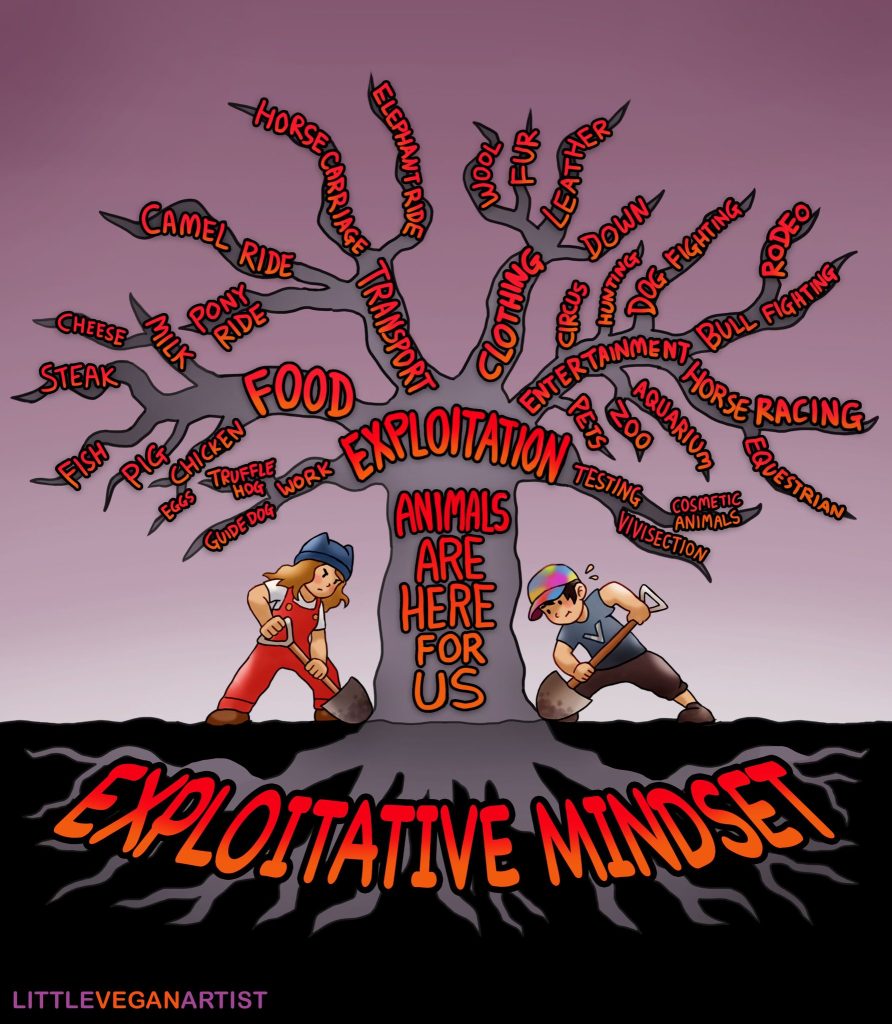
Therefore, the only long-term solution is to expose the root of the injustice: the very perception of animals as objects or property. In practice, eroding this sense of entitlement means:
- Bringing the victims back to the center of the discourse: Clarifying that by virtue of being sentient individuals with a will to live, they deserve full freedom, regardless of their utility to us.
- Putting them in the shoes of the victim: Challenging them directly (“Would you accept this excuse if you were in the victim’s position?”).
- Exposing the internal contradiction: Confronting them with the huge gap between their declared values (not harming the weak, compassion) and their actual exploitative practices.
- Demanding full accountability, not compromises: Do not offer “Meatless Mondays,” reduction, or vegetarianism. Every such compromise grants moral legitimacy to the exploitative mindset and confirms to the non-vegan that it is acceptable to continue exploiting – just a little less.
Avoiding some or all of the points I raised as a solution allows the non-vegan to evade accountability toward their victims, which leads to the next chapter – Lack of Accountability.
Lack of Accountability
“I am not personally responsible for the exploitation of animals. The victims are disconnected from my choices. Others are to blame – not me.”
Lack of Accountability is, in my opinion, probably the most common reason explaining why people are not vegan.
There are three critical components required to lead to taking accountability:
- Awareness: Internalizing the fact that the non-vegan’s choices create an individual, exploited victim, and that they are personally responsible for it.
- Agency: The conscious capacity to make free decisions. Many non-vegans truly and sincerely believe that we must consume animal products to survive and be healthy. As long as a person is trapped in this ignorance, they lack the true agency to choose otherwise. Once this wall of ignorance cracks – for example, when they realize a vegan diet is perfectly healthy or when they are exposed to an activist who properly represents animals – their agency comes to life.
- Taking Accountability: Taking full ownership of the consequences of one’s actions, without shifting blame and without excuses, manifested through the moral decision to stop exploiting animals.
Most vegans mistakenly assume that the main issue preventing people from transitioning to veganism is a lack of knowledge about what happens in slaughterhouses. But what non-vegans really lack is not information – it is accountability. This is not about a technical understanding of how a cow is slaughtered, but about the moral understanding that a cow is not an object, but a unique individual who lives for their own sake.
Non-vegans’ fear and unwillingness to take ownership of their actions are the exact fuel driving the excuses familiar to every activist: “plants have feelings too,” “I’m just one person out of billions,” or “the world isn’t black and white.”
As a result, they will also frequently engage in “victim erasure“ – framing the discourse as if there are no victims involved in the story. For example, they will say: “This is my personal choice,” “Stop looking into my plate,” or “That’s your opinion and that’s legitimate, but you need to respect my position.” This is a denial of reality and a total lack of honesty and integrity.
Lack of accountability is driven by two main factors.
The first factor is ignorance. This does not mean a lack of intelligence, but rather a lack of understanding that animals are sentient beings and what they go through, along with a lack of knowledge about the viability of a plant-based diet as a perfectly healthy option for them, alongside the failure to understand that they themselves are personally responsible for this exploitation.
But once ignorance disappears, a feeling of cognitive dissonance surfaces. Cognitive dissonance is the internal discomfort created when a person encounters a sharp conflict between their values on one hand (such as their self-perception as a good person who opposes oppression and believes animals deserve to live in freedom) and their actual actions on the other hand (exploiting helpless animals and depriving them of freedom). This feeling of discomfort forces the human brain to quiet this internal noise, so it will turn to one of three solutions:
- Resolving the contradiction by changing actions (veganism): The non-vegan aligns their values with their actions, chooses integrity, and accepts full responsibility. This is, of course, the only desirable scenario for the victims.
- Changing values and doubling down (rationalization): Instead of aligning their actions with their values, the non-vegan does the opposite – altering their values to match their actions. The non-vegan shifts their worldview and consciously adopts an exploitative ideology. They begin to generate philosophical or pseudo-scientific justifications for why the exploitation they demand is actually just and necessary.
- Repression: Dissonance is an oppressive emotion, and it is easier to silence it through distraction. The non-vegan simply chooses to look away – for instance, swiping away an advocacy video on Instagram to watch a football match instead, as if the victims do not exist.
This leads us to the second factor of a lack of accountability – the deep fear of guilt and moral failure.
It is unbearably difficult for a person to wake up one day and realize that for years they took an active part in an atrocity. The paralyzing thought of “How did I live like this until now?” threatens to destroy their self-perception as a “good person.” The moment a non-vegan understands the consequences of their actions, taking accountability requires them to admit they were wrong – and not just wrong, but that they caused real harm to animals they claim to care about. Therefore, it is psychologically easier for them to continue evading responsibility than to face the crushing weight of guilt from their past actions.
The key to real change for animals lies not merely in flooding people with information or exposing facts, but in the non-vegan’s ability to summon the courage to look in the mirror, overcome fear, and choose integrity and full accountability for their actions.
On the ground, dismantling the mechanism of a lack of accountability requires us as activists to:
- Hold the non-vegan accountable: Show the non-vegan that their daily decisions impact real, flesh-and-blood victims who did not and could not give their consent.
- Hold a mirror up to the hypocrisy: Confront them with the gap between their claim that they respect animals and their conscious choice to continue exploiting them.
- Force a perspective shift to that of the victim: Make them ask themselves whether they would accept the excuses they are making if they themselves were on the receiving end of the violence and oppression.
- Establish veganism as the only legitimate solution: Do not allow them to escape into interim solutions or “reduction” that merely quiet the conscience; instead, insist that veganism is their minimal moral duty toward the victims.
This ability to evade responsibility and repress guilt becomes far easier when society as a whole cooperates with you, which leads us directly to the next defense mechanism: Conformity.
Conformity
“If I change, I will stand out. I will be judged and mocked on multiple occasions: family meals, outings with friends, dates, and more. I am afraid of how non-vegans will see me as a vegan.”
Conformity (or conformism) is the tendency of a person to change their behavior, opinions, or beliefs to fit the accepted norms and rules of society.
It is rare for a non-vegan to admit out loud that this is a reason why they continue to exploit animals, but in rare interactions, some will raise this concern honestly.
We humans are social creatures. We all experience an innate need for approval and validation from those around us – from family, friends, coworkers, romantic partners, and even strangers.
But in a predominantly non-vegan world, where many non-vegans attempt both to shield themselves from guilt and to deflect responsibility, they will become hostile toward the vegans in their lives, because vegans serve as a moral mirror to non-vegans by their very existence.
Non-vegans will almost never admit it, but this deep fear of mockery and rejection is, for a large portion of them, a fundamental reason to continue inflicting injustice on animals – simply to blend in socially.
Most people will claim that they are not conformists. Yet numerous studies and history itself paint a different picture, showing that most people will commit immoral acts given sufficient social pressure.
Conformity is driven by two main factors:
- The fear of rejection: This is the immediate, day-to-day anxiety regarding negative interactions. The non-vegan understands that if they choose veganism, they will automatically become an “outlier” at every dinner table. The fear of rejection manifests as anxiety over public mockery, dismissive jokes at family meals, gibes from coworkers, or judgmental looks on dates. For many people, the need to avoid momentary social discomfort and confrontation with those close to them outweighs their conscience. They prefer to sacrifice their values – and the lives of the animals – just to avoid “making trouble” or “ruining the mood.”
- The fear of social isolation: This is a deeper, more evolutionary fear – the dread of being left alone and ostracized from the group. Food is one of the most powerful social tools for human connection. The moment a person chooses veganism, they fear a rift will form between them and their social circles; that they will no longer be invited to gatherings, that friends will drift away because “finding a restaurant for them is too complicated,” or that they will lose the sense of belonging and camaraderie they have enjoyed until now. Human society punishes those who hold up a mirror to it, and the fear of this punishment – of loneliness – paralyzes people from making the change.
In my opinion, the mechanism of conformity also provides a fundamental explanation for the gender gap in the animal rights movement, which has a distinct majority of women. It is socially acceptable for women to publicly express emotion and empathy. However, men are conditioned from a young age to believe that masculinity requires dominion over others – that being a man means ruling over the weak. Animal exploitation – exerting power over someone incapable of resisting – is the ultimate expression of this control. For many men, they perceive going vegan as weak since they’ve been taught that exerting control over others is a masculine action. Letting go of exploiting animals, they believe, will negatively impact their masculinity.
Breaking this conformity requires not just moral understanding, but courage and a backbone – the willingness to take the heat, the mockery, and the social estrangement, out of the understanding that the lives of the victims are infinitely more important than an infantile need to fit into the herd.
So, what is the solution?
- At the micro level (dealing with the individual): We have no way to influence how conformist the person in front of us is. But we can address the elephant in the room. If they agree in principle with the fact that they are living hypocritically, that animals deserve freedom, that they need to change, and that there is nothing substantial preventing them from changing, you can ask them about conformism – and whether their hesitancy to change stems from social anxieties. If they say yes, you can ask them directly: “Is your need for social approval so great that you are willing to let innocent animals be exploited for you?”
- At the macro level (movement strategy): We need to make veganism the social norm. People will fear transitioning to veganism less if there are already vegans in their social circles. I recommend reading the article here, which explains beautifully how to create a new social norm. We do not need a vegan majority to make a substantial change – sociological studies dealing with “critical mass” and norm dynamics show that once a determined group reaches a certain percentage of the population, the old norm begins to collapse.
But the fear of what others will say outside is only half the equation; often, the real barrier is not the pressure society exerts on us, but the internal war we wage against our own self-image – and this is precisely the mechanism of ego preservation.
Ego Preservation
“I am a good, rational, and moral person. Good people don’t do bad things. Becoming a vegan now means admitting that I was wrong about myself for decades – and that is a blow to my self-esteem that I refuse to accept.”
Ego preservation, or the defense of one’s self-identity, is probably the strongest psychological barrier preventing people from changing – especially when that change requires them to acknowledge that their daily behavior has caused exploitation and extreme suffering to innocent beings.
This is a psychological survival mechanism. The more a person perceives themselves as highly moral, a pursuer of justice, and a compassionate individual, the more defensive and volatile their confrontation with the truth of what they are directly responsible for regarding animals will be. The ego acts as a tough security guard at the gates of consciousness, filtering out any piece of information that might destabilize their self-worth.
This point also connects directly to conformity, since transitioning to veganism is also an admission that one’s entire family, all of their friends, and most of the people they respected are taking part in a terrible injustice themselves.
Ego preservation is driven by two central motives:
The first motive is the fear of an identity crisis – a threat to one’s moral self-image. Everyone has an internal narrative they tell themselves about who they are. This story usually includes elements like “I am a good person,” “I love animals,” and “I act rationally.” The moment you present a non-vegan with the facts, you aren’t just suggesting they change their menu – you are threatening to destroy this narrative.
The thought that “if I become vegan now, it means that until today I was complicit in a slaughter” is unbearable for the ego. To avoid the total destruction of their self-image, the ego would rather distort reality, attack the messenger, or invent absurd rationalizations, just so it doesn’t have to admit: “I was wrong, I caused harm, I participated in an injustice.”
The second motive is consistency bias and the sunk cost fallacy. The older a person is, or the more aggressively they have defended animal exploitation in the past, the deeper their ego is invested in the non-vegan position.
People are desperate to be perceived as consistent by themselves and by those around them. To change means publicly admitting they were wrong. The ego views a change of stance as a sign of weakness and defeat; therefore, it prefers to dig into its current positions, driven by the internal belief that “it is better to be consistently wrong than to admit that others were right and I was wrong.”
Here, it is relevant to mention the concept of moral disengagement. Psychologist Albert Bandura defined this theory as a series of psychological mechanisms that allow people to commit cruel acts without feeling guilt or a blow to their self-esteem. The non-vegan uses these mechanisms (such as anthropomorphizing plants or minimizing their share of responsibility) to sever the link between their conscience and the cruel action they are funding.
This is the main reason why many advocacy conversations turn into a playground of manipulation and tone policing. When a non-vegan feels their ego is in danger, they will stop listening to arguments against the animal exploitation they demand and start focusing on how things are said: “You are too aggressive,” “You’re guilt-tripping me,” or “Because of your approach, people won’t change.” This is a classic distraction tactic of the ego – turning the activist into the “bad guy” so that the non-vegan can remain the “good guy” in their own story.
So, what is the solution?
To bypass the ego’s defense mechanism, we must separate the person’s identity from their current actions, without sugarcoating or softening the injustice itself. Instead of attacking the person and calling them names (which would lock the ego into defense mode), we appeal to the values they themselves claim to hold, and show them that their actions contradict them. The outreach method of Anonymous for the Voiceless achieves this in the most elegant and effective way through Socratic questioning.
However, if you have reached a stage in the conversation where the non-vegan admits their moral failure, admits the hypocrisy, and admits they need to change yet hesitates to do so, there is a high probability that it is their ego preventing them from doing so. Therefore, you must address the elephant in the room (in a direct yet sensitive manner):
“Tell me, is it possible that despite your full agreement so far, is it possible that what’s stopping you from taking the step is simply your ego? That it’s just hard to admit that for your whole life you’ve acted in total contradiction to your values?”
If they are honest enough to admit it, present them with the deciding question:
“So, what is ultimately bigger? Your ego, or your heart?”
If they hesitate or evade, the answer is the ego. If the answer is the heart, they will transition to veganism on the spot.
But this digging-in of the ego does not stem solely from the need to feel “good”; it is also fueled by the human brain’s deep-seated fear of expending energy and stepping out of its comfort zone, which leads us directly to the next psychological barrier: Inertia.
Inertia
“Changing my perception of animals and changing my behavior require a mental and physical effort that I don’t have right now. If I change, it won’t happen in the present.”
Inertia is a physical law, but in the human context, it is a powerful psychological law: an object in motion tends to stay in motion, and a person on a certain life path tends to continue on it simply by virtue of habit.
Inertia is destructive even when the individuals holding onto it are the ones suffering from its consequences:
- Staying in an empty or toxic relationship: Leaving means confronting the negative emotions that accompany breakups, returning to the “dating market,” experiencing loneliness, and more. The person tells themselves: “Sure, things are bad, but at least I know what to expect.” The comfort and autopilot of routine triumph over the pursuit of happiness.
- Staying in a grueling, energy-draining job: To change professions or look for a new job, one needs to revamp their resume, go to interviews, risk rejection, and learn new material. The brain, which aims to conserve energy, prefers to stay on the existing path. The person enters a loop of chronic procrastination: “I’ll quit after the bonus,” or “I’ll look for something else when this project is over.” This is exactly the same illusion of “maybe I’ll be vegan in the future” that we encounter with non-veganism.
Inertia is driven by two central elements:
- Avoiding cognitive load: The human brain conserves energy. It loves automation. When a non-vegan walks into a supermarket, they operate on autopilot – their hand reaches for familiar products, their eyes scan shelves they’ve known since infancy, and the recipes are already in their head. Transitioning to veganism is perceived as a “project” – they think they need to start reading ingredients, relearn how to cook, look for specialty restaurants, and change household logistics.
When a person is exhausted from work, the kids, or life’s troubles, inertia triumphs over morality. They postpone the decision not because they disagree necessarily, but because the comfort of the present defeats the temporary discomfort of learning.
However, avoiding cognitive load is not just a matter of making logistical changes. In fact, that is rarely the case. The real cognitive load – the one the brain tries to evade at all costs – is the mental effort required to change the way it views animals.
From infancy, the non-vegan’s brain is programmed to operate under a mechanism of dissociation and separation. It has been trained to see animals in functional categories: food, clothing, products – rather than living individuals. Breaking this inertia means actively tearing down this mental defense shield. This means that every time they are hungry, every time they open the fridge or sit in a restaurant, they cannot just “choose a dish”; they are forced to expend mental energy to maintain the awareness that this is someone, not something. They have to confront the knowledge that they themselves were part of a mechanism of oppression, and rebuild a system of habits that changes their relationship to everything around them.
The brain, always striving to stay within its cognitive comfort zone, experiences this paradigm shift as a massive energetic threat. It is much easier and simpler to keep the old filters over one’s eyes and let autopilot continue to make the victims pay the ultimate price, rather than summoning the psychological resources to sober up. - Chronic procrastination: This is the mechanism by which the non-vegan agrees with you 100%, but shifts the responsibility to the future version of themselves. They will tell you: “I’ll be vegan when it’s easier,” “I’ll transition to veganism when there are more alternatives,” or “when I live alone and have more money.” This is a sweet illusion of the mind that allows a person to feel moral in the present (“after all, I plan to change in the future”) while they continue to fund the actual atrocity. This procrastination paralyzes the person’s agency, turning veganism into a distant goal for which the right time to start never arrives.
We sometimes mistakenly think that if someone says “this is too hard for me,” we need to solve it for them through recipes, substitutes, and culinary tips. But just like in the previous chapters, merely making practical solutions accessible only treats the symptom. The problem is not a lack of tofu recipes; the problem is a lack of moral urgency. When inertia rules, the non-vegan does not perceive the continued consumption of animal products as an emergency, but rather as a default state.
So, what is the solution?
- At the micro level (dealing with the individual): Since inertia stems from a desire to conserve energy, ensure that the energy required to remain a non-vegan exceeds the energy required to change. This means their cognitive dissonance must be absolutely clear and undeniable. To break inertia, one must trigger an emergency stop and shatter the illusion of “future time.” We need to make it clear to the non-vegan that time is not their theoretical resource – this time is measured in the lives of the victims. Place the non-vegan in the position of their victims.
When you recognize that the person in front of you agrees with everything but is stuck in inertia, you must hold up a sharp mirror to the present:
“Even if it feels hard for you, who is experiencing greater hardship – you, who simply need to make different choices at the supermarket and do a little Googling, or your victims who enter slaughterhouses in your name? Would you accept it if the person exploiting and abusing you used this excuse?”
Or alternatively phrased:
“If you don’t want animals to be exploited for you, why turn it into a process instead of deciding that from now on, you no longer want to be a person who exploits and oppresses animals?” - At the macro level (movement strategy): As a movement, we must remove physical and logistical barriers to make veganism the easiest default choice. The more accessible, affordable, and clear the vegan selection is in supermarkets, restaurants, and hospitals, the lower the “cognitive cost” of transitioning to veganism will be. When the distance between the moral decision and practical execution is smaller, the power of inertia decreases.
However, it is crucial to clarify – there is a myth within the movement that the “how” of veganism carries equal weight to the “why.” This is incorrect. Making vegan options accessible will not solve the problem of inertia unless non-vegans feel they need to make the change. As a cautionary tale for the rest of the world, the vegan movement in Israel became highly neutered starting in 2020, as the focus shifted away from the urgency experienced by the victims and toward accessibility, as part of a supposedly “pragmatic” approach.
This means that, with far greater importance, we must ensure that as many people as possible confront the harsh reality they impose on their victims and understand that they are personally responsible for it. Consequently, the energy required to remain in the status quo will be much greater than the energy required for them to change.
Closing Statement
These five reasons – Exploitative Entitlement, Lack of Accountability, Conformity, Ego Preservation, and Inertia – are not superficial excuses; they are complex, intertwined psychological mechanisms. When we understand these mechanisms, the chasm between us and non-vegans ceases to be a frustrating mystery and becomes a clear map.
In fact, these mechanisms do not operate in isolation, but rather feed into one another in a symbiotic loop: It all begins with Conformity – a person is born into a society that dictates to them that animals are products, which breeds an Exploitative Entitlement toward them in their mind from a young age. To live in peace with this exploitation and maintain the ego of a “good person,” their brain immediately activates mechanisms of a Lack of Accountability, removing guilt from themselves (“everyone does it,” “I’m not the one slaughtering”). This split allows them to continue operating within the Inertia and autopilot of routine, without experiencing the moral crisis that would force them to change. Each mechanism is a line of defense – if you manage to destabilize their inertia, their brain will flee to their exploitative mentality. When you challenge their exploitative mentality, they will entrench themselves in ego preservation.
The reason non-vegans do not change, even when they agree with us in words, is almost never a lack of knowledge or a shortage of culinary alternatives. It stems from the fact that human society has built a multi-layered defense system around animal exploitation. This system nurtures an exploitative mentality (entitlement), allows them to disconnect themselves from the consequences (lack of accountability), rewards them for blending into the herd (conformity), protects the moral narrative they tell themselves (ego preservation), and lulls them to sleep within the comfort of autopilot (inertia).
As activists, our role is not to beat around the bush regarding these mechanisms. We are not here to sell them on how veganism is “easy,” “tasty,” or “trendy,” because every such compromise only reinforces their default choice to put their own comfort at the center. Our role is to hold up the mirror with a steady hand, unapologetically and without blinking.
The real solution, at both the micro and macro levels, is always to bring the focus back to the victims and demand integrity, courage, and full accountability from the person in front of us – here and now. Don’t just treat the symptoms of exploitation – go to the root of the problem and uproot it.
Honesty without compassion is merely cruelty, but compassion without honesty is manipulation.
If we slam the truth in a non-vegan’s face in a cold, detached manner that is insensitive to the psychological mechanisms driving them, that is honesty without compassion – an act of cruelty and ego on our part, which will not advance the victims’ cause but will only cause the other side to entrench themselves in their positions.
On the other hand, if we soften the facts, offer compromises like “Meatless Mondays,” play nice, pander or nod in agreement when they make excuses just to avoid creating discomfort, that is compassion without honesty. And that is manipulation. It is manipulation toward the non-vegan to make them feel comfortable, and above all, it is a betrayal of the victims who are being slaughtered at this very moment while we sugarcoat reality.
True compassion for the victims requires radical and direct honesty with the non-vegan. True compassion toward the non-vegan is not leaving them mired in their own lies and illusions, but holding up the mirror to them in the clearest possible way, out of a deep understanding of their difficulty, yet with an absolute refusal to compromise on the truth.
Ultimately, the transition to veganism is not an act of dieting or a social trend; it is the ultimate test of human character. It is the demand to place your moral backbone above the need for social approval, above temporary comfort, and above personal ego. Our goal is to continue dismantling these mechanisms one by one, conversation after conversation, until the injustice that is clear as day to us becomes an inescapable norm for everyone.
Leave a Reply